case law

Mani v The Information Officer Mintek

In Mani v The Information Officer Mintek, Mani made a request to the Information officer of Mintek in terms of PAIA to determine the source of an email containing defamatory information about her. The court ordered Mintek to provide [...]

By |2022-12-19T11:51:03+02:00January 22nd, 2021|Categories: Access to Information|Tags: , , |

Discovery vs Liberty judgment | Data ownership

The Discovery vs Liberty judgment adds weight to the argument that the data subject and not the responsible party owns their personal data. Data protection law puts the control back in the hands of the data subject. It gives [...]

How does an ordinary reader understand a contract

It looks like in the future courts will decide what a contract means based on what an ordinary reader understands it to mean, rather than by following the traditional laws and rules of interpretation. Article about interpretation Malcolm Wallis recently [...]

By |2022-12-13T14:16:20+02:00November 30th, 2019|Categories: Plain Language|Tags: , , , , , |

Black Sash Trust v Minister of Social Development

In Black Sash Trust v Minister of Social Development, the Constitutional Court agreed with the Information Regulator that data subjects own their personal information and that a responsible party cannot transfer the data subject's personal information to another party. [...]

My Vote Counts v Minister of Justice and Correctional Services

In the judgment of My Vote Counts v Minister of Justice and Correctional Services, My Vote Counts won the right for the public to know the source of a political party's funding. This enables voters to make informed decisions when [...]

By |2024-01-31T07:39:52+02:00June 21st, 2018|Categories: Access to Information|Tags: , , , , |

President of the Republic of South Africa v Office of the Public Protector

In President of the Republic of South Africa v Office of the Public Protector, the Court confirmed the authority and powers of Chapter 9 Institutions. Similar to the Public Protector, the Information Regulator can also hold others accountable for their […]

Cochrane Steel Products v M-Systems Group

Digital advertisers should take note of Cochrane Steel Products v M-Systems Group. Whilst advertising through Google Adwords, many people bid on keywords that include the trademarks of their competitors. For example, if you sell a drink like Coke, you want people searching [...]

By |2021-10-21T16:25:26+02:00June 1st, 2016|Categories: Marketing Law|Tags: , , |

Makate v Vodacom – the 5 minute speedread

The ‘David v Goliath’ saga of Makate v Vodacom, which proceeded all the way up to the Constitutional Court, highlighted the risks organisations face if they fail to properly address the ownership and commercialisation of potentially lucrative ideas created by their employees. Key take-away’s of Makate [...]

By |2022-12-19T11:43:58+02:00May 26th, 2016|Categories: Intellectual Property Protection|Tags: , , , |

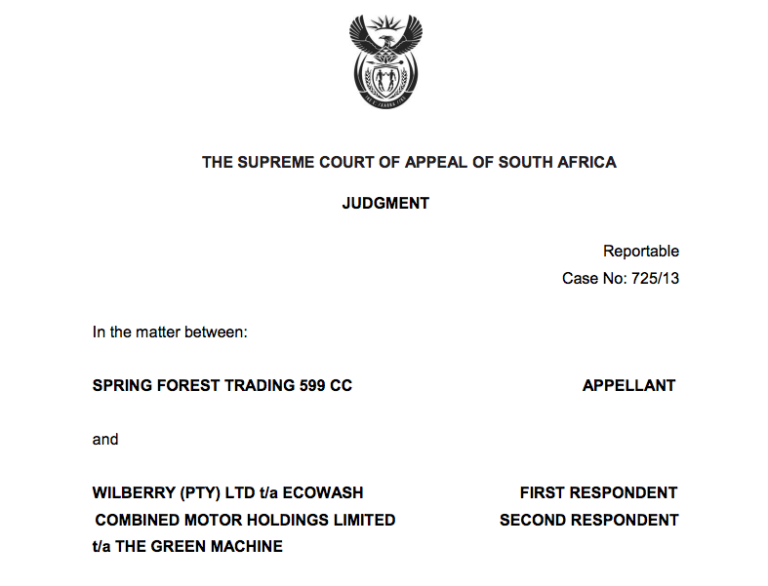
Spring Forest Trading v Wilberry | Electronic signatures binding

Is it possible to cancel a contract and to sign it with just the use of emails? In the case of Spring Forest Trading v Wilberry, the South African Supreme Court of Appeal held that electronic signatures were binding and [...]

“Fraudulent” access to an IT system containing unprotected public data

Is it an offence to access data that is freely available on the Internet? Many of us would think that it isn’t if the data is accessible to the public. Can a person use public data (that may include public [...]

Standard Bank v Dlamini | Victory for plain language and consumer protection

On 23 October 2012 Justice Dhaya Pillay handed down a judgment in the Durban High Court, which might prove to be a victory in the war against legalese and unfair contract terms. One of the biggest questions was whether Mr [...]

By |2022-12-20T13:14:04+02:00February 27th, 2013|Categories: Plain Language|Tags: , , , |

Dutch Reformed Church Vergesig v Sooknunan

In Dutch Reformed Church Vergesig v Sooknunan, the Court ordered Sooknunan, the owner and publisher of a Facebook page, to remove certain posts as they were unlawful in content and impact. The Court held that people posting the Church members' […]