Karabo Mokoena

About Karabo Mokoena

Karabo has a forward-looking approach to tech regulation, she sees the law not as a hurdle but as a springboard for innovation. Passionate about empowering businesses to find lawful paths to transformation, she combines creative problem-solving, practical legal design, and an impenetrable will to succeed Read more ...

Artificial Intelligence in the South African financial sector | FSCA AI report

Artificial Intelligence in the South African financial Sector is a fast-growing use case. The way it will be regulated is noted in our earlier posts on the latest developments in AI regulation. South Africa will adopt a risk-based, technology-neutral and industry-specific [...]

By |2026-02-27T17:52:38+02:00February 11th, 2026|Categories: AI Governance|Tags: , |

The South African AI Act: latest developments

There will be no standalone South African AI Act. Instead, South Africa will have a sector-specific, risk-based approach to AI regulation. This approach aligns with international best practices followed by the UK and Australia, which seek to use existing laws [...]

By |2026-02-11T14:33:21+02:00January 27th, 2026|Categories: AI Governance|Tags: , , , , |

Lessons to learn from the Information Regulator priotities

Understanding the Information Regulator's priorities is no longer just good practice; it's essential to avoid enforcement action. Having attended the Regulator's recent stakeholder breakfast, we can distil the key lessons and confirmed changes that will shape the compliance landscape in […]

Information Regulator stakeholder engagement in Cape Town

The Information Regulator stakeholder engagement revealed the regulator's thinking on how to comply with the Protection of Personal Information Act (POPIA) and the Promotion of Access to Information Act (PAIA). More importantly, the regulator confirmed expected amendments to the POPIA [...]

Director due diligence includes AI literacy | Section 76 Companies Act

Director due diligence includes AI literacy. This is because Section 76 of the Companies Act requires a director to exercise their powers and perform their functions with care, skill and diligence. To act diligently, a director must make informed decisions. [...]

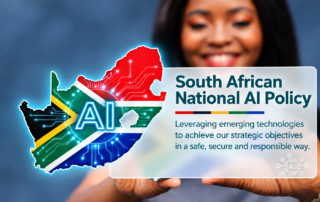
AI Policy Template and practical guidance for organisations

An AI policy template for organisations is different from a National AI policy framework. A National policy outlines how a country plans to govern AI to advance its national interests. An organisational AI policy explains how your organisation uses AI, [...]

By |2025-11-17T09:12:58+02:00November 14th, 2025|Categories: AI Governance|Tags: |

AI Policy for Public Healthcare in the Western Cape

The AI policy for public healthcare in the Western Cape (WCG) is in motion. The policy promotes the use of AI tools to address institutional capacity constraints and varying skill levels. Meaning that developers and deployers of AI-enabled healthcare tools [...]

By |2025-10-24T14:18:50+02:00October 24th, 2025|Categories: AI Governance|Tags: , , |

Anthropic AI copyright settlement clarifies fair use

A U.S. district judge in the Anthropic AI copyright settlement clarifies the concept of fair use when it comes to AI training. In essence, AI developers may train AI on books that they lawfully acquire. The infringing act, however, is [...]

Truecaller enforcement action | Caller ID & spam blocking

The Information Regulator (Regulator) is investigating Truecaller. Data subjects complained about how, among other things, Truecaller processes personal information. There is currently no enforcement notice against Truecaller, but the investigation signals a shift. Data subjects in South Africa are actively […]

GPAI laws under the EU AI Act effective from August 2025

As of 2 August 2025, the EU AI Act Commencement date for GPAI laws has come into effect, introducing new regulatory obligations for GPAI providers. Although, earlier this year, critics warned that the law could stifle innovation, regulators admitted [...]

By |2025-10-01T10:59:47+02:00September 22nd, 2025|Categories: AI Governance, Tech Law|Tags: , , , |