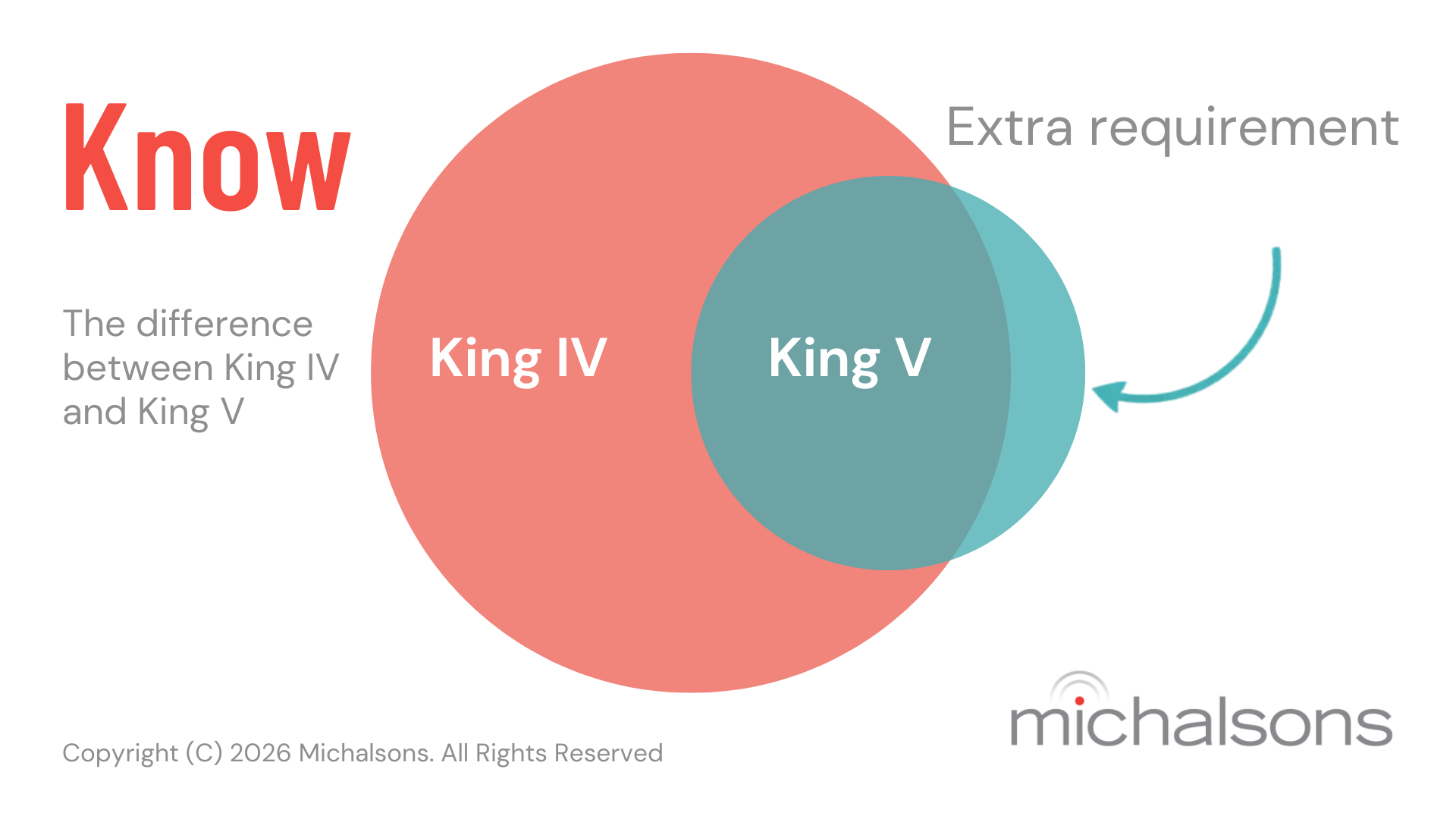
You need to understand the difference between King IV and King V. What does the difference between King IV and King V mean? King V is effective for financial years that start on or after 1 January 2026 and officially supersedes King IV in its entirety. Knowing the difference between the two will help you understand what you need to tweak in the actions you are already taking under King IV to comply with King V.
People are asking these questions:
- What is the difference between King IV and King V?
- How do I transition from King IV to King V as quickly and easily as possible?
- What if I’m implementing the King Code for the first time?
Many people have spent considerable time and money applying King IV. Understandably, you don’t want that effort to go to waste. Even though King V replaces King IV entirely, you can build on what you have already done and just do the extra things King V requires.
King V has replaced King IV in its entiretly, but King IV practices overlap with those in King V.
If you have not previously applied the King Code, understand the difference between King IV and King V. This will help you properly plan how you will apply King V. Without understanding how King V differs or what extra requirements it contains, you will not be able to apply it properly.
We can help you transition to King V
Having a summary of King IV and King V to compare provides you with valuable insight, but it does not cover all the important ground. We have developed King IV-to-King V comparison tables that detail all recommended practices for both King Codes. The table highlights the differences or additional requirements in King V that you need to know. The table also outlines the additional governance steps you must take to comply with King V.
Transitioning from King IV to King V is easy when you have our comparision tables.
In addition to the comparison table, we have developed a King V planning tool. You can use it internally to outline the governance areas you focused on in the previous financial year (or reporting period) and those you plan to focus on in the next.
Actions you can take
- Get the tools to help you implement King V by purchasing our King Code Toolkit, designed for King V.
- Understand how the King V addresses IT GRC by reading our plain language overview.
- Know how the JSE listing requirements interact with the King Code.
- Apply the recommended practices and explain how you have applied them by asking us to help you frame your disclosures.
What has changed is the structure and scope of the King Code
King V has consolidated several King IV principles, reducing the total from 17 to 13 principles. This removes redundancy and makes King V more accessible. Notably, King IV’s Principle 17, which applied only to institutional investors, has been removed from King V. The King Committee has instead endorsed institutional investors’ application of King V alongside the Code for Responsible Investing in South Africa.
King V also introduces a deconstructed format. Instead of a single document, The King Report comprises four standalone documents: King V Foundational Concepts, King V Code, King V Glossary and King V Disclosure Framework. This makes the King Code easier to navigate and use.
The King V Disclosure Framework is a significant addition. It standardises the form and content of disclosures against each recommended practice. Organisations can no longer rely on vague or generic disclosures because King V requires specific disclosures for each practice.
King V requires specific disclosures for each practice, this raises the bar for transparency and accountability.
Difference between King IV and King V regarding Data, Information and Technology Governance
King IV and King V differ significantly in their approaches to IT governance. In King IV, IT governance fell under Principle 12, which addressed technology and information. While King IV refers to “Technology and Information”, King V elevates the role of data by explicitly adding it to the principal title: “Data, information and technology”. King V introduces detailed practices for the entire data lifecycle, including its acquisition, creation, use, dissemination, and disposal. It also specifically mentions:
- Data Architecture: Structuring data resources to optimise management
- Classification: Identifying and classifying sensitive data to enable effective control
- Quality: Adhering to specific quality requirements for data and information
King V splits Principle 10 into two distinct sections with separate practices for each. Practices 100 to 104 deal with the governance of data and information. Practices 105 to 110 deal with governance of technology. This structural split requires the governing body to set strategic direction, approve IT policies and seek periodic assurance separately for data and information on the one hand, and for technology on the other. Under King IV, a single set of governance steps covered both, but under King V, you need to address them distinctly.
King V and AI governance
Practice 109 in King V introduces explicit oversight of emerging, innovative and disruptive technologies. This is a new obligation that did not exist under King IV. The governing body must oversee the organisation’s acquisition, development, use and distribution of such technologies. It’s important to create sustainable value and to properly assess the associated risks and opportunities.
Practice 109(c) specifically addresses artificial intelligence (AI). It requires the governing body to ensure that the organisation’s use of AI adheres to key values, including:
- transparency in how AI systems are designed, data is sourced and how AI systems work.
- explainability by being able to provide clear, understandable reasons for specific AI decisions or outputs.
- human centricity in your AI approach that enhances human capabilities and is guided by fairness, justice and privacy with the aim of preventing harm and bias.
Transparency, explainability, and human-centricity are fundamental to the ethical deployment of AI, its trustworthiness, accountability, the identification of biases and errors, and enabling users to understand, verify, and even challenge AI-driven outcomes in regulated and general use.
The addition of this section reflects the growing regulatory and governance focus on responsible AI governance. Having an AI governance programme in your organisation will help you establish clear accountability for decisions, actions, outputs, and outcomes of AI systems.
Under King IV, service provider governance was also relevant to IT governance. King V retains the requirement that the governing body oversee the effective management of risks related to outsourced technologies, including minimum assurance requirements. This sits under Practice 108(f) and is more clearly scoped than its King IV equivalent.
You need to understand the full scope of King V
To understand the full scope of differences and the additional governance steps that King V requires, you can read our King IV to King V comparison table for DIT Governance and use our King V planning tool to assess and plan your governance activities.