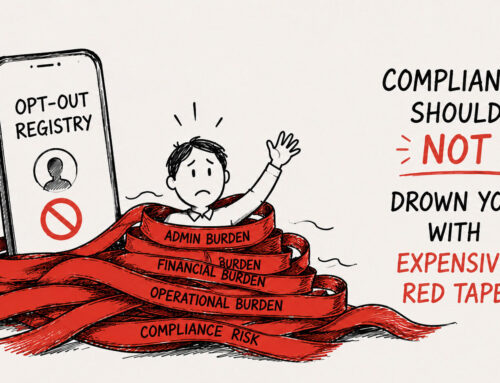
The NCC published their draft guidelines for compliance with Opt-Out Registry regulations in Government Gazette No. 55465 on 2 October 2026. The guidelines explain how the Commission reads section 11 of the CPA and the 2026 Amendment Regulations. They set a registration cut-off date and operational rollout times. They confirm that marketers must cleanse their lists monthly and that consent does not override a pre-emptive block. The Opt-Out Registry Compliance Guidelines also expand more on who exactly is considered a direct marketer.
The deadline to comment on the draft guidelines is within 15 days of the date of publication. Therefore, the final date is 17 October 2026.
Who does this apply to?
The draft guidelines for compliance with Opt-Out Registry regulations expand on the definition of a direct markerter. The definition applies to anyone who promotes goods or services directly to consumers by telephone calls, SMSs, e-mails, messaging applications, online platforms or any other form of electronic communication.
- The guidelines apply to any person or business that markets goods or services directly to consumers.
- They apply in every industry and to every product or service marketed directly to consumers.
- Using third-party organisations on your behalf to do your marketing doesn’t let you off the hook. You are still responsible for compliance.
- Robocalls and other automated calls count as direct marketing when they promote or sell goods or services.
- The one exclusion is “omnichannel” retail where the consumer makes contact first, for example when a customer reaches out to you.
- A sole proprietor with annual turnover under R2 million can be both a consumer and a direct marketer, if registered as both.
- The definition of a direct marketer doesn’t include political parties campaigning for votes, but it may include them when they ask for campaign donations.
- The definition doesn’t automatically exclude NPOs. It covers them when they ask for donations, but not when they share information or raise awareness.
It does not prohibit ordinary business engagements that are not primarily promotional or marketing communications. In other words, before you message a customer, ask yourself why. Are you just keeping them updated, for example by telling them their order is on its way, reminding them of an appointment, or sending their statement? Or are you trying to sell them a product or service? The first is fine. The second is marketing.
What do the Opt-Out Registry guidelines mean for you?
The NCC Opt-Out Registry is going to be in full swing and it is imperative you sign up before the end of December 2026, as that is the deadline to register on the system if you are a direct marketer, before being in contravention of Section 11 of the CPA. According to the NCC’s launch statement, cleansing is free for five months, from December 2026 to April 2027. This is so marketers can learn the process and set up their systems. The fee applies from May 2027, when consumers can also start registering blocks. The free period comes from the launch statement, not the draft guidelines.
Disclaimer: the guidelines are not binding on the NCC, the National Consumer Tribunal, or the courts, but anyone applying the CPA must take them into account. They set out how the Opt-Out Registry works, but the NCC, Tribunal, and courts can still consider other factors case by case.
Actions you can take
- Understand the draft guidelines for compliance with Opt-Out Registry regulations better by reading it here.
- Have your say on the draft guidelines by sending your comments to the NCC by 17 October 2026. You can:
- email them to both [email protected] and [email protected]; or
- deliver them by hand to the National Consumer Commission, 01 Dr Lategan Road, Block C, Groenkloof, Pretoria.
- Learn how to register on the portal correctly and before the cut-off by joining our webinar on 25 November 2026.
- Follow our regulatory updates for the latest on the Opt-Out Registry by reading related posts on Direct Marketing.
- Contact us if you need help with registration, cleansing, or identifying whether your communication processes may constitute direct marketing.