
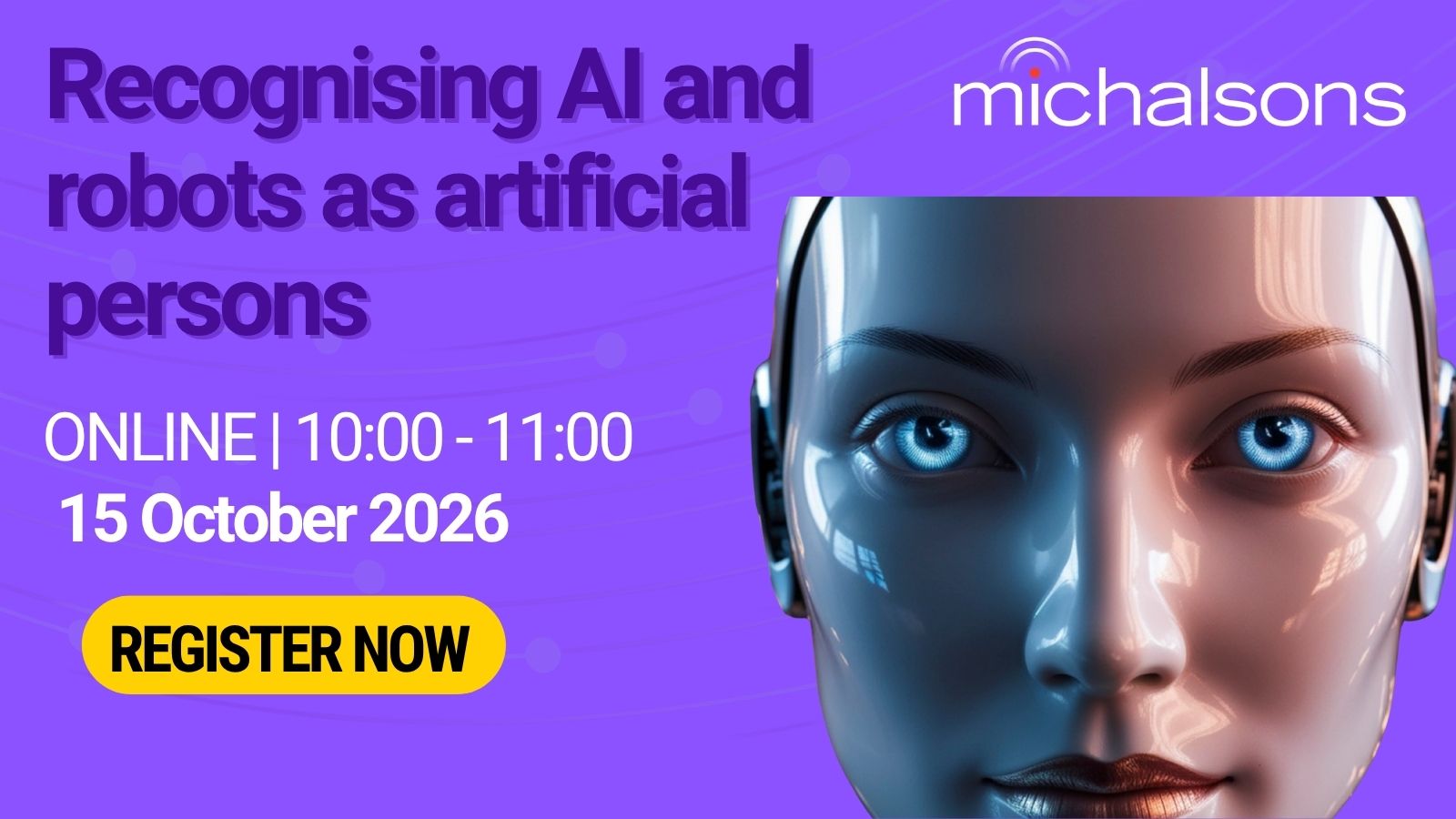
Webinar | Recognising AI and robots as artificial persons
15 October @ 10:00 am - 11:00 am
Instead of asking whether AI or robots are conscious, we should consider whether practical and legal reasons exist to treat certain AI systems or agents as artificial persons.
Join us as we explore how recognising a new type of person – the artificial person – could be a creative, and perhaps not so new, tool for thinking about governing them. This would enable them to enter into contracts, have rights, and be held accountable
The law is surprisingly flexible when it comes to granting personhood. It is willing to recognise something as a legal person when practical or societal reasons demand it. The law saw the utility of giving companies legal personhood (juristic persons), and that same utility can translate to governing AI and robots.
This webinar is a prelude to the Lexing conference on the Robotics and AI Revolutions.
No matter how closely robots resemble us, whether in appearance or in function, they aren’t natural or juristic persons. They are machines that can perform human-like tasks, which may not have our input at all, but which may still have legal effects. And, as technology grows more sophisticated, so too will the tasks they perform – and their potential consequences.
What you’ll learn
- How the law’s idea of a person has changed over time.
- How humans or natural persons are evolving.
- How juristic persons came to be recognised, and how that status keeps changing. For example, POPIA protects juristic persons as data subjects.
- Why AI and robots need their own legal category: the artificial person.
- How recognising artificial persons can form the foundation of AI law.
- What this means for building harmony between people and machines.
Outcomes
- Have a different perspective on AI governance by using the law’s existing approach to legal personhood as a new lens for thinking about AI governance.
- Strengthen your contributions to AI regulation debates by using a practical framework for analysing personhood, responsibility and accountability in consultations, policy discussions and regulatory work.
- Contribute with greater confidence by applying the artificial person concept to questions about how we should regulate increasingly autonomous AI systems and robots.
Panel
John Giles is the host and has done extensive work on this topic. He presented on this topic in 2015 in Paris at an International Conference entitled Robots: evolution or revolution?. One of his goals in life is to create harmony between natural and artificial persons (humans and robots). He has written about the topic, including a Comparative Handbook on Robot Law.
Karabo Mokoena will be joining. She has a master’s in Technology Law and Innovation and has conducted extensive research on experimental regulatory mechanisms for AI governance, particularly for highly autonomous agents.
Who should attend
Anyone thinking seriously about how to regulate or govern AI or robots, including policymakers, regulators, legal advisers, AI governance officers, compliance officers, academics, and technologists.
Also, corporate executives and decision-makers, entrepreneurs, business owners, and anyone who wants a different understanding of how to govern AI.
Bookings
The webinar is held on Zoom.
Members and non-members:
Free for all attendees (not just members of our programmes). Please register for the event by clicking on the red register button below. If you find value in this webinar, please consider joining a Michalsons programme.